Photo story
Aurora Borealis or SAR?
On Sunday, the Northern Lights once again reached central and partly southern Europe because of increased solar activity, which is expected to last for another two years or so. This year, the Northern Lights had already been visible in Slovenia in April.
At our latitude this phenomenon is very rare, while at the North Pole it is quite common!
But was what we saw and photographed really the Northern Lights (Aurora Borealis) or some other phenomenon?
Like many others, I went hunting for it on Sunday too—too late. The aurora was most pronounced at around 18:00, and the western part of the country was mostly covered by dense cloud. Still, I caught a very brief, small patch of clear sky, placed the camera on the roof of the car and pointed it upwards. I noticed nothing unusual with the naked eye—my eyes had not yet fully adjusted to the dark either—but on the screen I saw a reddish-pink glow behind a cloud. I did not get another attempt: the clear patch and the time of the main event were moving mercilessly farther away from me.
A little annoyed, I later realised that in my only—and very poor—attempt, I had not actually captured the aurora, but SAR.
SAR is misleadingly named "Stable Aurora Red", because it is not stable (it changes shape) and it is not an aurora. It is indeed red, but it is a different celestial phenomenon.
An aurora forms when charged particles from the Sun strike the Earth's atmosphere and excite oxygen and nitrogen atoms, which then glow green or red/blue. The green colour of an aurora is characteristic of the North Pole, while at lower latitudes the Northern Lights are usually reddish-orange.
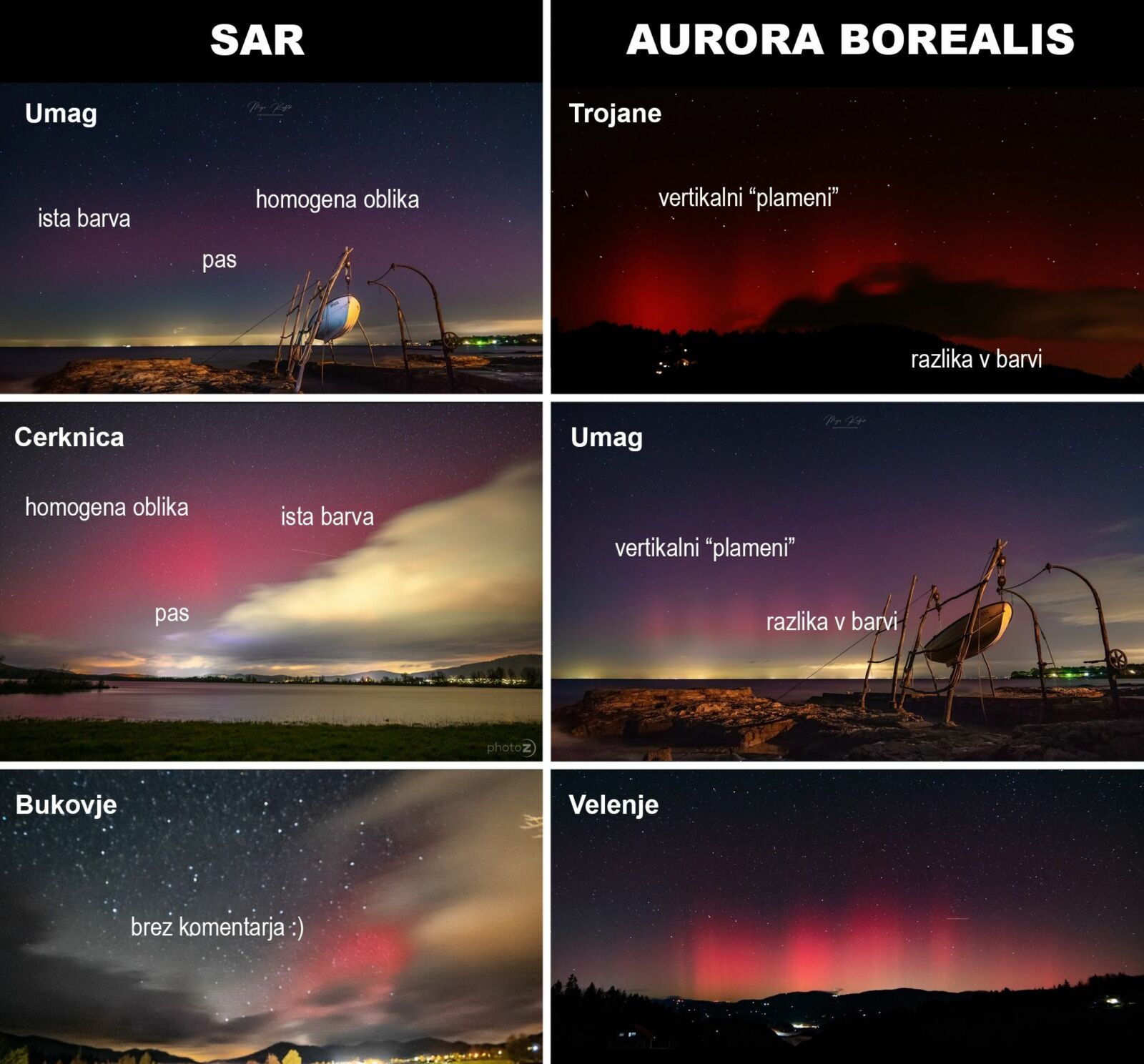
SAR forms because of prolonged heat dissipation from the Earth's radiation belts. Besides having a different cause, the difference between SAR and an aurora can also be recognised visually:
- the shape of a SAR band is homogeneous; a band is visible, with no vertical components in the form of
- an aurora has irregular shapes and vertical columns, and looks like a flame
- SAR glows in a single colour—red—while an aurora often has different colours
- an aurora is considerably brighter than SAR
- SAR is barely detectable with the naked eye (wavelength 630 nm)
- an aurora occurs at high latitudes and, during strong solar activity (K index 7+), also at middle latitudes
- SAR occurs at middle latitudes
- an aurora changes shape faster than SAR, so SAR looks stable (it seems not to change)
- SAR can remain visible for a day after an aurora if the cooling lasts that long. SAR can be visible even if the aurora does not reach us, or if there is no aurora at all!
- formation: aurora—bursts of particles from the Sun; SAR—heat dissipation from the magnetosphere into the thermosphere-ionosphere
- an aurora forms in the atmosphere, while SAR forms much higher—in the magnetosphere at an altitude of 400 km
An analogy:
If an aurora is the flame on a gas burner, SAR is the burner's still-hot, glowing metal after the flame has gone out.
Or:
I rushed to photograph a heavenly barbecue fire, but by the time I arrived the fire was out, only a few red embers remained, the food was already cold, everyone had left, and it had started raining too 🙂
On the first of April we joked with fake photographs of the Northern Lights. A few days later they really appeared. Then on Sunday they appeared again, much more intensely. Some people managed to capture them for real, while others did not.
There will probably be another opportunity to photograph them in our area too, if we have better luck with the weather.
Keen astrophotographers probably already know the difference between SAR and an aurora. I did not before this event, and as a result I learnt a great deal.
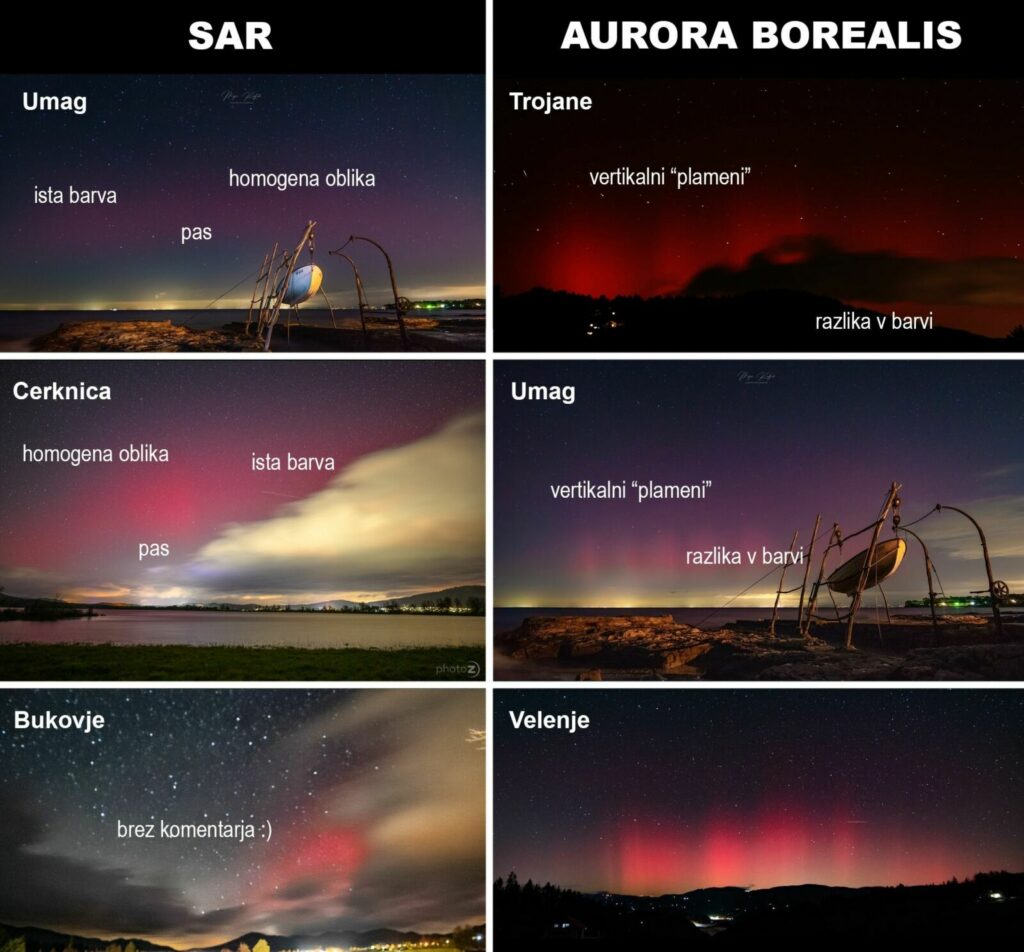
The images are from social media; one is mine. The authors are named in the photograph captions, while two successful aurora photographs have no credit: they were taken by Iztok Miklavčič and Aleš Rozman.
"Stable Red Aurora (SAR)" and "Northern Lights" refer to different phenomena, although both involve interactions between the Earth's atmosphere and particles from space.
1. Northern Lights (Aurora Borealis)
- What it is: The Northern Lights, or Aurora Borealis, are a natural light phenomenon visible in high-latitude areas near the poles. They occur when charged particles from the solar wind collide with gases in the Earth's atmosphere, causing them to glow.
- Colours: The most common colours in auroras are green, yellow, blue and violet, but red or pink may also appear, depending on the type of gas and the altitude of the interaction.
- Where it appears: It is most visible near the Arctic, in places such as Norway, Sweden, Canada and Alaska. The Southern Hemisphere has a similar phenomenon called the Aurora Australis.
- Nature: A dynamic and changing phenomenon in which the shape, brightness and colours can change rapidly. The phenomenon depends heavily on solar activity—it is stronger during solar storms.
2. Stable Red Aurora (SAR Arc)
- What it is: A Stable Red Aurora (SAR Arc) is a specific type of red aurora, but it is much rarer and has different causes from ordinary auroras such as the Northern Lights.
- Cause: SAR forms because of low-energy particles trapped in the Earth's magnetic field, rather than high-energy collisions of particles from the solar wind in polar regions. This phenomenon occurs at considerably lower latitudes than ordinary auroras.
- Colour: SAR is recognisable by its stable red colour, which is produced by emissions from oxygen atoms at a very high altitude (about 400 km), where they emit red light. Unlike the dynamic changes of the Northern Lights, SAR is stable and persistent, often extending for thousands of kilometres.
- Where it appears: SAR can be observed at middle latitudes, such as the United States or Europe, during geomagnetic storms.
Summary:
- Northern Lights (Aurora Borealis): A colourful and dynamic phenomenon caused by collisions between solar particles and the atmosphere, visible mainly near the poles.
- Stable Red Aurora (SAR Arc): A rare and stable red aura caused by low-energy particles in the magnetosphere, visible during geomagnetic storms at lower latitudes.
The sources from which I summarised these findings are listed here.
- https://doi.org/10.1111/j.1468-4004.2012.53116.x
- https://spaceweather.com/
- https://spaceweatherarchive.com/2023/11/08/earths-ring-current-system-just-sprang-a-leak/
- https://spaceweatherarchive.com/2021/11/22/3308/
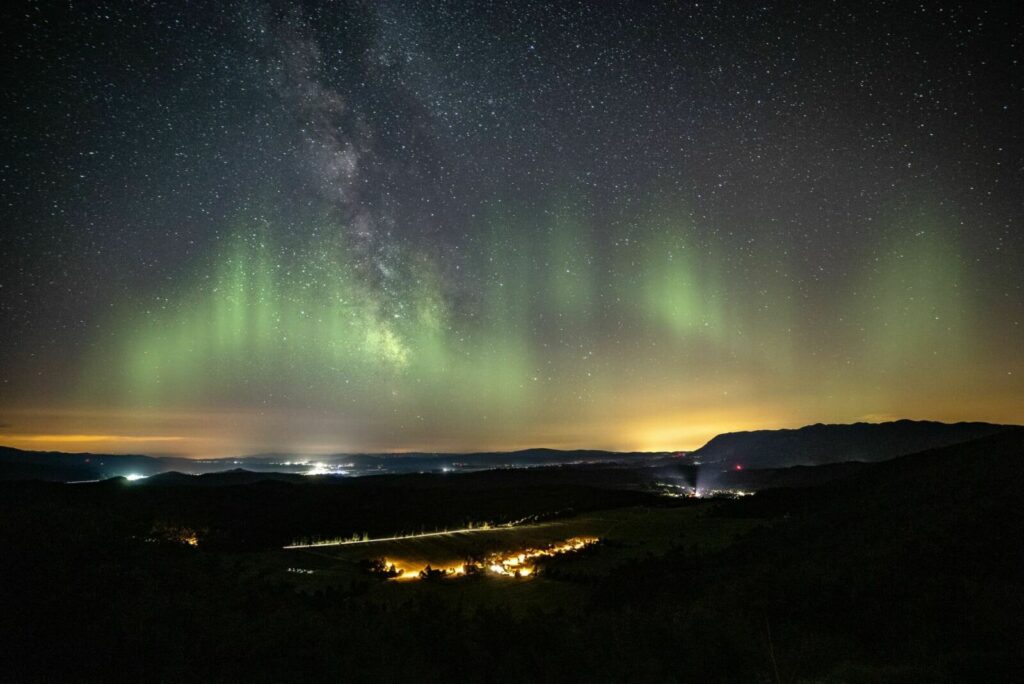
April Fools' Day!